By: Emily Miller
War/Peace reporting – Syria in the Global Media. (n.d.). Retrieved from http://eip.org/en/news-events/warpeace-reporting-syria-global-media
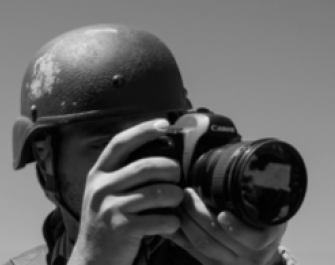
I want to delve into the important and necessary constructs of both war and peace journalism. These two aspects of reporting allow us as to humans to see genuine and undeniable facts as well as feel our emotions to the fullest extent due to a photograph.
Blakemore, E. (2016, July 22). War Correspondents Are No Longer Spies in the Eyes of the Pentagon. Retrieved from https://www.smithsonianmag.com/smart-news/war-correspondents-are-no-longer-spies-eyes-pentagon-180959890/
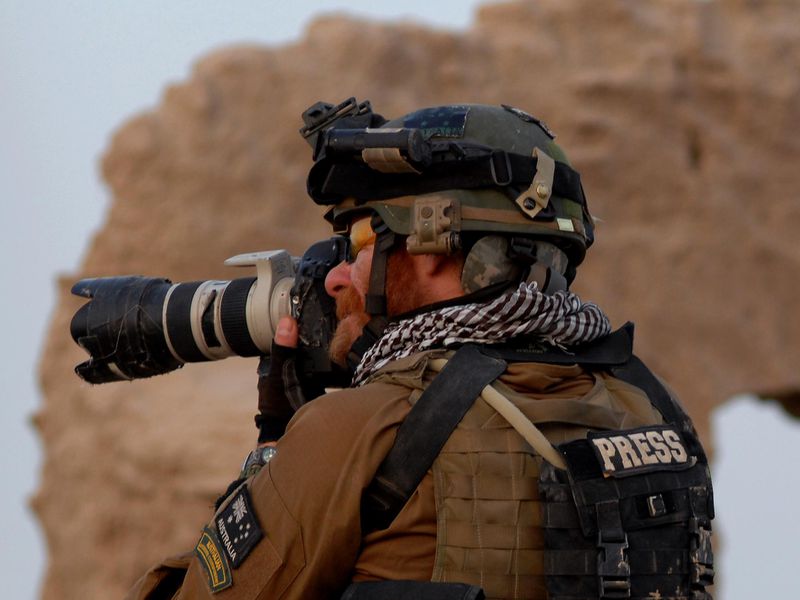
War journalism is reporting characterized by “us vs. them” narratives that demonize them, the spreading of propaganda, and reporting that is victory oriented, reactive, and elite oriented that focuses only on the visible aspects of violence. War Journalism normally encompasses a lot violence. Violence is normally only presented as only it’s own cause, ignoring the possibility of structural or psychological causes. Violence is assumed to have no cause or explanation. This can be seen for example, in the deprived needs of certain parties. Conventional conflict reporting may lead viewers to believe that the only reasonable or “natural” way to respond to violence is with more violence. Sometimes more violence tends to be the only way that makes sense to people to react with more violence, like an unspoken language. With that being said, unfortunately non-violent responses can be considered irrelevant or unrealistic.
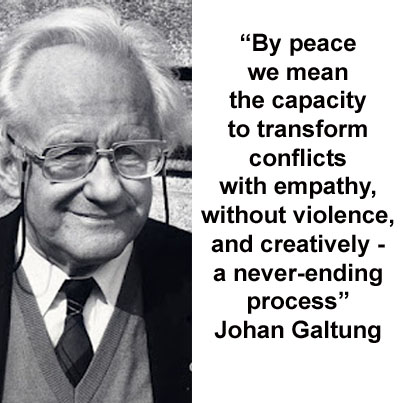
Galtung presents the differences between war journalism and peace journalism as two competing frames in the news coverage of conflict.
Johan Galtung’s Conflict Transformation Theory. (2015, October 21). Retrieved from https://arirusila.wordpress.com/2015/10/21/johan-galtungs-conflict-transformation-theory/
I want to discuss the concept of peace journalism and Johan Galtung’s work. Peace journalism is the opposite of war journalism. It is reporting that is proactive, humanizes the other side, gives voice to everyday people and allows discussions for solutions. Johan Galtung coined the term “peace journalism” in the 1970’s. He was a Norwegian peace researcher. Galtung believed that there is a bias towards violence, especially when covering topics of war and conflict. Galtung also said all bias can be avoided. He had an alternative approach for the mainstream news media’s reporting practices especially in times of conflict. Galtung also believed “journalists have to learn to write about peace and core structural issues and to focus on common people”. Galtung came up with four different elements of “newsworthiness criteria”.
- The event involves high-ranking countries
- The event involves high-ranking people
- The event involves actors rather than processes or structures
- The event is negative (Johan Galtung)
Galtung also states that peace journalism is equivalent to solution indicative reporting. Meaning the main goal of peace journalism is to try to find a solution to these problems. Peace journalisms approach can be used to guide reporting about any type of conflict (politics, ethnic, civil unrest, religious, etc), and not just those that involve violence or war.
Today, conflicts such as those in the Middle East allow us to see how Galtung’s concepts and theories are used today. I came upon an article about the causes and consequences of the conflicts in the middle east. I found what I read to be solution seeking thus leading me to believe it is peace journalism. “While there have been encouraging recent signs of incipient diplomatic coordination between the US and Russia regarding Syria, given the magnitude of the crisis of sectarianism, much more must be done, particularly in light of the unabated tensions between Saudi Arabia and Iran. Indeed, not least for the sake of the welfare of their own citizens, the two Gulf states, as regional players, must be forced to the same table of negotiations.” The first element of peace journalism is applicable here. The first element states peace journalism is proactive, examining the causes of conflict, and leading discussions about solutions. This is applicable because they are clearly stating there needs to be something done.
 Emily's Blog