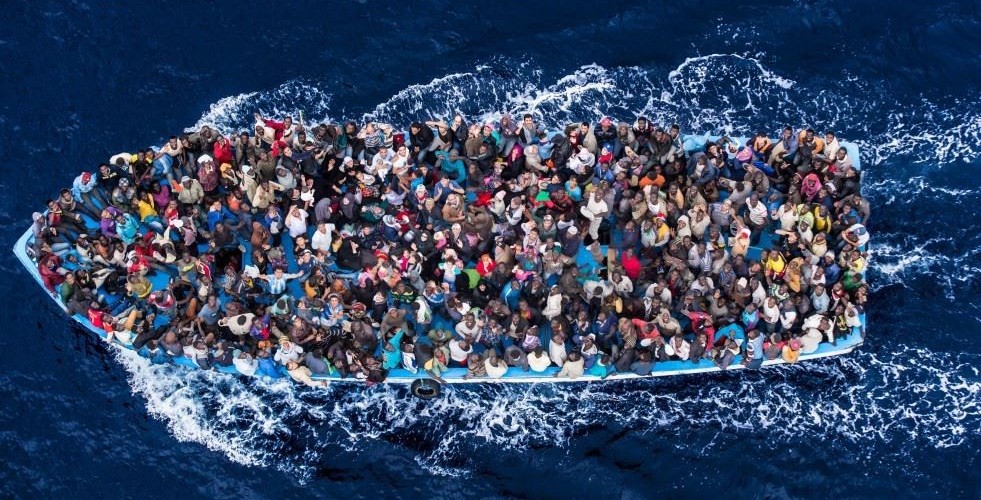
The Washington Post’s waypoint informed us greatly on the European Union Refugee Crisis. According to The Waypoint, “with land routes largely blocked more than one million refugees are forced to use boats to travel from the Turkish shores to seek asylum” (The Washington Post) in places like Greece. The boats made for only twenty are packed with fourty people or more. The journey is a long, hard one. People are dying in the sea and washing up on the shores of the surrounding countries. The smugglers who get them onto the boats and across the waters charge as much as $1,000 per person, charging even more for a life jacket. Often the asylum seekers spent the night in the forest without any food or any water. This is a waiting period for them, they are waiting for the smugglers to order them to the waters edge and take them to seek asylum. This is then the point the migrants are then sent on their way in the boats while the smugglers stay behind as their job is done. Once on the boats it is not all smooth sailing. Many face engine issues, or people who cannot swim being casted overboard. Rescuers are only given minutes to retrieve the people out of the cold, deep, deadly water. Many of the boats have been drifting through the sea for hours leaving their passengers wet and shivering. The most horrific detail is the fact that the boat ride for them was the best part. Even though yes still horrible they were so relieved to be leaving Syria. The amount of babies, and young children is astonishing. Watching the amount of suffering and the quantity of people enduring the suffering is gut wrenching. This is a problem that needs an immediate resolution as lives are being lost each day. Many items have been washed ashore and or left behind to dry where newcomers can be welcomed with a fresh, dry pair of shoes. Wallets, children’s toys, family photos, were all left behind. Once landed, it takes only minutes for the asylum seekers to get back on their feet and continue their journey. Once they arrive at the registration center they are then given a ticket and told to wait. They are waiting for an interview in which they are asked are you Syrian or Afgan? Are you traveling alone or with family? The way they answer these questions determines the course of their journey on the island. Thousands of people arrive to the island daily many of which do not a passport or an official form of Syrian identification. One camp is designated for families, and the other is for everyone else. Every new arrival has their fingerprints and photo taken and they are screened by national origin. The total combined capacity of these two particular camps is 2,800 people. In the fall however daily arrivals exceed 6,000 people. Some days the camps feel like ghost towns and other days they are overflowing with people. This depends on the pace of the arrivals which is nearly impossible to predict. Stays in camps can vary from being there for a few hours, to a few days. The refugee camps fill and empty quickly. Once emptied, the humanitarian crews come in and prepare the camp for the next round of arrivals. Once asylum seekers have been registered they are then given a document allowing them to move freely within Greece. Many of the people are not staying in Greece, they are going to wherever in Europe they either have family or can afford. The refugees arrive all on rubber dinghies and are then placed onto ferries that have normally been used for tourism but are now being used day and night to transport asylum seekers. From the mainland asylum seekers journey their way across Europe, through Greece, Macedonia, Croatia, Slovenia, and Austria.
The Waypoint: Journey alongside refugees through Lesbos, the gateway to a new life. (n.d.). Retrieved from https://www.washingtonpost.com/graphics/world/lesbos/
Berry, Inaki, Moore, & Kerry. (2016, February 11). Press coverage of the refugee and migrant crisis in the EU: A content analysis of five European countries. Retrieved from http://orca.cf.ac.uk/87078/
Photo From: Library Specials. (n.d.). Retrieved from https://www.peacepalacelibrary.nl/library-special/refugee-crisis-in-europe/
 Emily's Blog